Total Pageviews

Friday, June 15, 2012

Prefatory to Anything Else

So here we are in Ireland. The trip here was a little bit of crazy. I won't bore you with details except to say that the Belgian train website times bear no relation to the actual train times. Sprinting was required.

But we are loving the Irish. All our taxi drivers have met Bono. They all know who James Joyce is. A bus driver gave me a disquisition on Brendan Behan. They have very strong opinions about the austerity budget, and though they blame us for starting the financial meltdown, they have forgiven us.

They're not quite as good at driving as at literature. One cabbie took us to the wrong tower, not the Martello Tower/Joyce Museum. Sensing our desperation, a couple who owned a taxi but weren't working decided to drive us around looking for it. During the drive, the woman recited poetry to us: "The Ballad of Redding Gaol" and several of her own compositions. She was about to embark on "Paradise Lost" when, thankfully, we arrived at our destination.

We got to the museum just it was closing for lunch, so we ate at a local pub dedicated to James Joyce. I ordered gorgonzola cheese, just to get in the mood.


Joyce's room at the Tower,
When the Tower reopened we were first in line. Phil, having recently written on Stephen Dedalus's time at the Tower, was in Joyce heaven.

As we left, it began to rain. I dropped Phil at the Joyce conference at University College Dublin, where he sat in on  a panel given by two of his doctoral students, who worked with him 24 years apart.

Afterward, in a deluge, we took the panelists out for Guinness, and then went on to dinner with additional Joyce fanatics. Phil ate many organ meats, and the other Joyceans ordered enormous quantities of wine. I partook rather too much, but the Irish had just lost their football match, so you couldn't tell my stagger from anyone else's on the street.

The city is thronged with Joyce wackos, including Phil. By tomorrow many of them will actually be dressed as James Joyce. I am afraid...

Thursday, June 7, 2012

Fez Fantasia*

Fez. A magical place. Full of beauty, strangeness, a smothering heat. Like Marrakech, but without the total insanity. As our riad host said, Marrakech comes to life at night, while Fez lives by day. It's a very religious city -- in fact, though I was dressed in short sleeves and a knee-length skirt, I was repeated jostled hard by men who apparently found me immodest. (Once, the guy responsible was taken to task by a passing veiled matron, which pleased me immensely.) I changed into long harem pants. Much more acceptable.

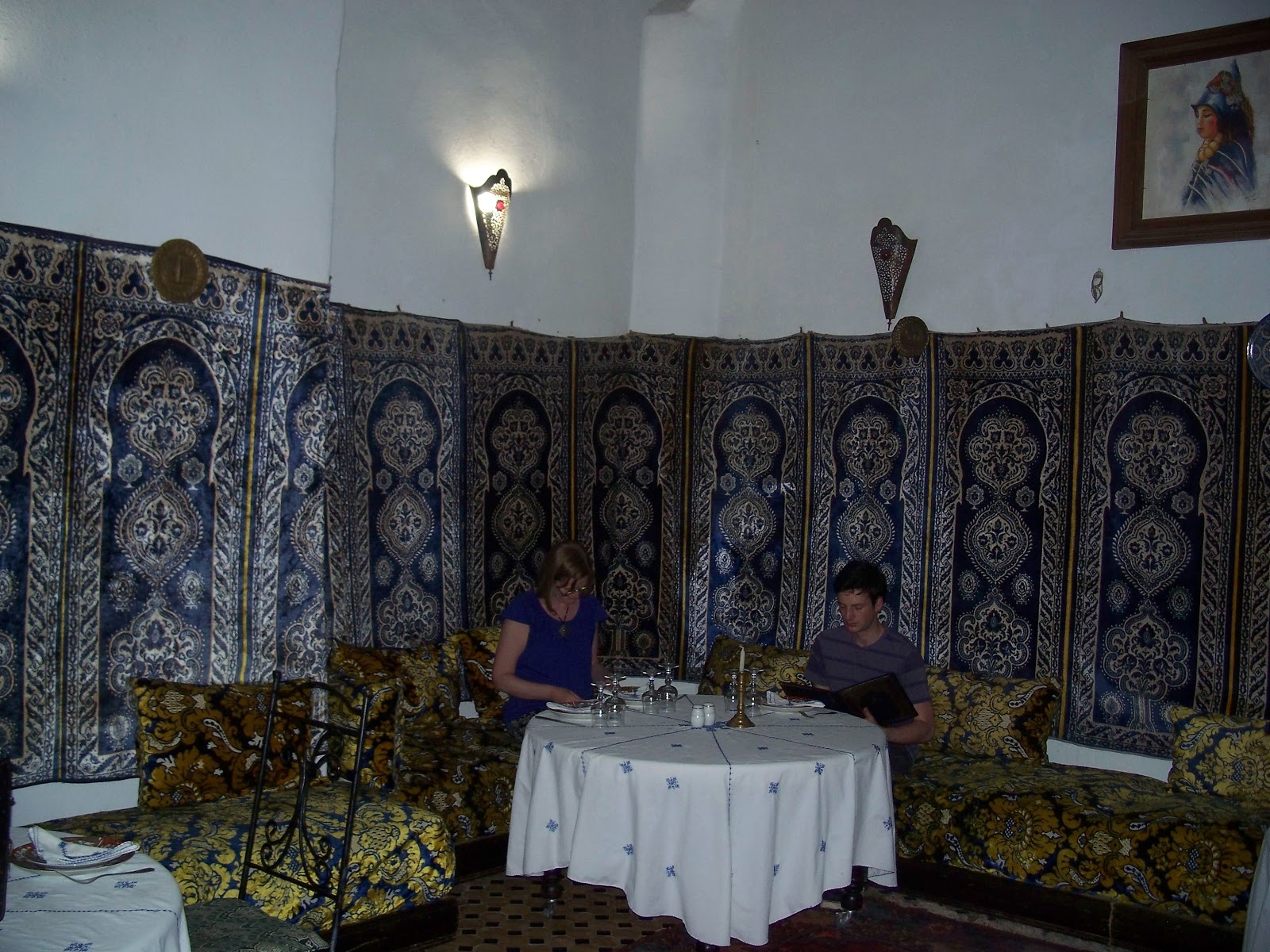
Our riad
On our first morning I was completely unable to get out of bed, exhausted and sickened by the endless drive through the desert. Our riad was a lovely place to lounge away the early hours, and by noon I was up and ready to go. We turned down the (quietly insistent, extremely persuasive) offer of a guide and set off with an incomplete map and the slightly terrifying information that there were 1200 streets within the medina. We were sure to get lost.

We found our way to the Blue Gate, the Bab Boujaloud, and then entered the maze of the souks. No vespas, thank god, but many mules. As Edith Wharton says, "The distances in Fez are so great, and the streets so narrow, that all but saints or humble folk go about on mule-back." We are humble folk, obviously. Plenty of sellers enticing, imploring, cajoling us to buy. The insistence was of a gentler nature than in Marrakech. In fact, "to Marrakech" has now become a verb in our family.


And buy we did, but with a certain intelligence that we'd lacked in Marrakech. We could bargain. We could say no. Well, almost.

We headed to the Fondouk el-Nejjarine, once an inn, or caravanserai, for travelers, now the Musuem of Wood. Many very bad jokes were made. I will leave them to your imagination. It was peaceful and beautiful, housing carved wood objects -- doors, musical instruments, and furniture.

Not far from the caravanserai, we visited the most sacred site in Morocco, the tomb of Moulay Idriss II, the founder of Fez. We were able to peer in through the door to see the tomb and the pilgrims there, but as non-Muslims we couldn't enter.

A long trek back to the riad, where we rested and cooled off (I had chosen all our riads with air-conditioning, and a good thing -- it was over 100 in the desert, and at least 95 in Fez).

Then out again to the Royal Palace area, where we strolled through a formally laid-out garden, full of fountains and cool shade, and then found a rooftop restaurant.


We ate tagines and skewers of meat overlooking the Bab Boujaloud, with hundreds of swallows darting past as the sun set and the muezzins called from three mosques surrounding us.

In the morning we set out for the Dar El-Batha Museum, Fez's main ethnographic museum. It's in the palace of Moulay el-Hassan, a ruler of Fez in the nineteenth century. We looked at illuminated manuscripts, ceramics, embroidery, and woodcarving in its cool interior. After that, we found the fourteenth-century Bou Inania Medersa, one of the ancient, beautiful schools of Fez, with a mosque attached.

We still had some time before catching a taxi to the airport, so we wandered through the souks to the El-Attarine Medersa. Built on the same plan as the other medersas we'd seen, it had a central courtyard ringed with rooms for students and for prayer. The tile and plasterwork were breathtaking. And the walk back to the riad was sweltering.


Our return trip was uneventful, though exceedingly long. Taxi to the airport, flight to Charleroi, taxi to the train station, train to Brussels, train to Gent, taxi to the apartment. I do have to give a shoutout to Ryanair. We've had four flights on the airline, and though there were absolutely no comforts provided, they were remarkably efficient. Each landed on time or early (though with considerable bouncing). And the passengers, knowing exactly what they were getting, applauded each landing and cheered at the triumphal music they played. Really, some larger airlines could take lessons. The extra charges for just about everything are irritating, but they let our overweight bag (2 kilos of Moroccan purchases!) go through for free.

So...Morocco. I learned a little something about myself there. I was not quite the world traveler I thought I was. The country was challenging in a way that was utterly new and exciting, and sometimes a little frightening. Driving through the desert, getting lost in the medinas' mazes, dealing with a completely unknown and patriarchal culture -- all was fascinating.

NOW I'm a world traveler.


*For a description of a Moroccan fantasia, go here.

Wednesday, June 6, 2012

Long Day's Journey Into Night

It did indeed take us 12 hours to get to Fez, as warned, and we didn't even go the way we intended. At the last minute, our host at Sawadi kasbah told us that the road to the Cascades D'ourzoude is a "piste." This was a new French word for me. It took a while for me to figure out that it means "dirt road." Change of plans.

We decided to stick to the bigger road, which would be mostly paved, and take a short detour up the Dades Gorge. Another crazy drive, with intensely beautiful views. There were rock formations known as the Doigts de Singes (because, you know, they look like fingers). There was a place way up top where we bought a stained glass lantern and a rug (there is always a place to buy stuff). It was so beautiful that we drove for an hour in it.

Then back to the desert moonscape. I'd learned that the black rocks were volcanic; I have no idea at what point the area had volcanoes. It was a very long way across the desert before we started up into the Middle Atlas. Six hours, in fact. We listened to strange Berber music on the radio. Saw Bedouin tents among the rocks. Wondered what the skinny donkeys and goats were eating in the bleakness. Marveled at the women walking along the road in long robes and head scarves, carrying huge baskets of greens from the nearest oasis to feed their livestock. Were amazed at a vivid turquoise saline lake, in a rock landscape without people or plant life around it. At a speed trap, the cops stopped us. Every few miles there's a speed trap -- you can drive 100 km/hr for about 5 minutes, then it goes down to 60. The police spent quite a lot of time looking at our papers, then informed us we were going 13 km over the speed limit, and it would cost us 300 dirham. Right now. Relieved (300 dirham is about 39 dollars) we handed it over. Then they took Phil out of the car. I pictured Midnight Express. I wondered if I could drive a stick shift over the mountains to Fez to get a lawyer. I panicked completely. Phil, on the other hand, had a nice chat with the policemen. When they found out he was from New York, they asked him what the capitol was, and when he correctly answered "Albany," they gave him back the 300 dirham and then sent us on our way.

The landscape became greener immediately. It was a relief to the eyes, reminding us that we are creatures of the north. There were cows, fields of grain, multicolored flowers. Fields full of storks (I immediately thought "Ostriches!" but luckily didn't say it.)

We passed into the Foret de Cedres, part of a national park, where I was startled by more animal life. I wasn't smart enough to stay quiet this time but shouted, "Monkeys! Monkeys! Monkeys!" The mockery was intense. They were Barbary apes, as Ben pointed out, living happily among the trees with a group of shaggy dogs, who appeared to be herding them as if they were sheep.

Then we got to Ifrane, a new, wealthy town that looks very European -- some of the houses are even half-timbered. The king has his summer palace there. We were searching for the Cascades des Vierges, or Waterfalls of the Virgins. Got very lost, but finally found them. We don't know why they're called that, but we had an interesting time speculating.

We raced to Fez, trying to get to the airport to return the car before dark, and made it just in time. The airport was sort of closed. There was certainly no one at the Budget office, though I'd made arrangements to drop the car off at that hour. Luckily, a kind gentleman let me use his cell phone to call the Budget guy, who obviously never had any intention of being at the airport at all. We worked things out (I had to pay the nice gentleman for the use of his phone, and then I had to pay him more). And finally we found a taxi to take us to our very lovely riad in the Fez medina. It was well after 10 by then, and we hadn't eaten. Our host gave us mint tea and called a friend of his who came to pick us up to take us to his house in the old Jewish quarter, a fifteenth-century structure, which doubled as a restaurant.

We had the best meal of our trip. And we returned to our room and collapsed in utter exhaustion.

Tuesday, June 5, 2012

Under the Sheltering Sky

Dearest readers, I’m writing this in Word to post later on the blog because we have no Internet access. BECAUSE WE ARE IN THE SAHARA DESERT.
But as usual, let me backtrack.
We drove from the seaside at Essaouira back past Marrakesh to the Atlas Mountains. Up. And up. I knew our hotel – an ecological dar, or house, in the High Atlas – was six kilometers up a dirt road. I had no idea that the road was a series of insane switchbacks without any kind of guard rails, leaving a sheer drop of many thousands of feet. By the time we arrived, I was sweat-soaked and trembling. Ben was trembling. Phil was gaseous. But good lord was it worth it.
We were offered almond milk and dates, then mint tea and salted nuts. We needed two snacks to recover.
Dar Tassa is an exquisite bed and breakfast hanging off the side of an Atlas cliff with nearly endless views down the valleys. We hiked up the mountainside and then down to the stream, which was still running though most wadis here are dry by now. Waded in Atlas waters, read books (they had E. Nesbit in the dar library!) in the Berber rooftop tent. Then we ate a wonderful dinner on the rooftop, listening to the muezzin’s call to prayer and watching the moon rise over the mountains.
In the morning we set off back down the switchbacks – so much easier on the way down! – and then drove through the mountains to the desert. What a road. It was mostly paved but generally only about 1.5 lanes, which made oncoming traffic a heartstopping challenge. Few guardrails. Astonishing and terrifying views. And all in standard shift.
We stopped at the thirteenth century Tin-Mal mosque, one of two mosques in the country that non-Muslims are allowed  to visit. It is no longer used for religious observance, but it is serene and beautiful, set high on a hill in a tiny village that was once a bustling center of commerce. Then we crossed the High Atlas at the Tiz-n-Test Pass at 7400 feet. The margin of error for the driver (Phil) was zero.
The mountain road finally deposited us on another road that runs along the edge of the Sahara. We drove past fields holding nothing but enormous red rock boulders.
Past buttes carved of black and purple rock. Past small groves of argon trees with occasional goats climbing up them. (Yes, goats climbing trees. Really.) Past long stretches of a frighteningly monotonous moonscape of brown rock.
Past camels. The sun blazed down unrelentingly. The road twisted and turned, losing its pavement now and then.
We stopped to see the Unesco World Heritage site Ait-Benhadou, a medieval town with four towering kasbah built of mud brick still beautifully preserved. We drove through Ourzizate, which had a ridiculously gigantic movie studio where The Sheltering Sky and Kundun were filmed.
We were dizzy with sun, heat, and exhaustion when we finally reached the six-kilometer dirt road that led to our hotel.
And now we’re in a beautiful kasbah (a fortified dwelling) set in the middle of a gorgeous palm oasis on the edge of the Sahara. This part isn’t the dune-covered Sahara of The English Patient (sadly, no Ralph Fiennes wrapped in bandages and dying slowly and beautifully in our room).  But there is a swimming pool, and they serve wine here. The dinner was exceptional – a cumin-flavored soup made from “a brother of the carrot” (any guesses?), saffron flavored fish tagine, and what seemed to be a deep-fried rice pudding. If we die in the desert tomorrow, we die full and happy.
Here it is Sunday, and we are still alive. In fact, we had a marvelous day. We spent the morning lounging by the pool and treating our fierce sun headaches, then set out for the historic Amerhidil Kasbah in the Skoura palm oasis, a seventeenth-century structure that has been restored. A member of the Glaoui family who originally built the kasbah lo these many centuries ago took us through it. He explained the various rooms and the implements that were found in the stable, where they had been successfully hidden from the many invaders who’ve overtaken parts of Morocco at various times in its violent history.
We then drove deep into the palm oasis with Mustafa, a mostly French-speaking, turbaned Berber who claimed to have “only one wife, but many French amies who come to visit in September and October. My wife does not mind!” At least I think that’s what he said. He was quite dashing, so it was easy to believe. Mustafa renamed us Ibrahim (Phil), Ismael (Ben) and Asni (me) and guided us on a wild drive through the oasis, pointing out the old Jewish kasbahs and cemeteries (there is only one Jewish family left in the oasis, though there are 35,000 people living there in tiny villages of mud-brick houses that can’t be seen from the main road).Ben saw a hoopoe. No sign of fennec foxes, sadly.
Mustafa brought us to a friend’s carpet and jewelry shop, where we drank mint tea, admired many gorgeous and pricey carpets, and bought necklaces. Then he showed us the Dades River, one of the two rivers responsible for the oasis’s existence, where many small boys were leaping into the water with joyous abandon.
Back at our kasbah, we swam, and Ben and I had massages – mine of the feet, his of the skull. Thank you, Kaz, for the birthday massage, so belatedly realized! It was wonderfully relaxing, curing my severe mental strain from so much speaking of French. Ben claims his head has never been so loose. We devoured yet another delicious dinner and are now about to go to bed early, as we’ve been told our drive tomorrow to Fez will take at least ten hours and perhaps twice that.

Friday, June 1, 2012

Moroccan Fauna

The drive from Marrakech to the coast was fascinating -- miles of a wasteland of rock and sand with occasional bright patches of green planation groves of olive and argon trees. We passed dozens of people walking along the road, which seemed to stretch from nowhere to nowhere. Where did they come from? Where could they possibly be going?


The coastal town of Essouaira is amazing, though it has a few too many vowels. It's quiet, breezy, very peaceful after the madness of Marrakech. But I'm tired, and it's late. So I will let photos tell most of the story.


Now I understand why Eeyore
 is who he is


In Jemaa el-Fna Square


Charming cobras
in the square


Catch of the day -- including moray eels.
 Also some endangered stuff.

Stork on minaret


Lawrence & Lawrence Jr.


A friend who joined us in our swimming pool. For its sake, I hope unchlorinated. For my sake...


Thursday, May 31, 2012

The Perpetual Flux and the Immovable Stability

After my words about Marrakech, readers have accused me of having lived too much in the first world. I admit it's true. Except for a trip to Costa Rica (where we were very comfortable, because it was the off-season), I've traveled entirely in Europe, the Caribbean, and North America. So...welcome, Diane, to the rest of the world.

We were doing better by dinnertime last night. We ate at a tourist place, but it had its unusual touches. It was a 17th century palace, and the location for a scene from Hitchcock's The Man Who Knew Too Much.


It also had a sort of belly dancer, Xtreme version.


Today we stayed away from the souks. It was easier to find our way. Our reflexes were better; there were fewer near misses with motorbikes. We were forced into only one unintended tour, and we only overpaid a little for it.

We started out at the Saadian Tombs, from the 16th century. They include three ornate, enormous mausoleums containing marbled tombs of  Ahmed el Mansour and his family and descendents.


Then we took a taxi to the Majorelle Gardens and Berber Museum. The gardens were exquisite. They're known for two things: the blue color with which much of the plasterwork and tile is painted, and the fact that the house and garden were owned for a while by Yves Saint Laurent.


After that, we went to the Dar Si Said Museum, in a 19th century palace. The sultan who lived there had four wives and eight concubines. When troupes of dancing men performed for the sultan, the women watched through screens upstairs, looking down and across into mirrors that reflected the dancers so they didn't look directly at the men.  

Then we were hijacked by a tour guide, who took us around to a dozen or more workshops -- huts, really, where men crafted metal, glass, and wood into gorgeous lamps and tables.


Our final stop with him was the government pharmacy, which made and sold herbal cures for anything that might ail you. Phil was quite intrigued by the mandrake root, offered as a cure for baldness. But I pointed out that it was both poisonous and hallucinogenic, so we decided against it.


After delicious tagines,we walked over to admire the Koutoubia mosque in the moonlight, finishing off with ice creams on the Jemaa el-Fna square while watching the nightly parade of crazy.

Tomorrow Phil gets to drive. We may find ourselves longing for the alleyways full of Vespas again.